
The $40,000 Mac Pro

The new Mac Pro is a pretty amazing device. For the last decade or so, the top of the line system has been a 40 pound behemoth housed in a hulking aluminum case. This latest version is in a tiny cylinder. The difference is size is jarring. The old systems were 20.1″x8.1″x18.7″. The new ones are 6.6″ x 9.9″.
That tiny cylinder is packed full with the latest and greatest: The latest Xeon processors (up to 12 cores), dual GPUs, PCIe-based storage, Thunderbolt 2, support for 4k video. It really is remarkable, both as a design, and as a marker of where our technology is heading. Systems will be shipping in December, for a starting price of $2999.
If, however, you have a few extra dollars to throw at your computing solution, there is a one-of-a-kind option. Jony Ive and Marc newson have put together a special edition of the new Pro to be auctioned off for Red at Sotheby’s. The estimated price going in is $40,000 – $60,000.

People are crazy!
Here’s a crazy video for your Friday. I saw this bouncing around my copy of the internet the last couple days. It’s GoPro video from Kelly McGarry’s run at the Red Bull Rampage. And yes, it is amazing. But you don’t really get just how amazing it is until you see this course from a different angle. The realities of the GoPro being mounted to Kelly, and the change in perspective that comes with that, take a lot of the elevation out of what is really happening. To give you an idea, have a look at this highlight reel. And, of course, don’t try this at home… or at work… or anywhere… ever.
Guillermo del Toro’s Bleak House

There are man caves, and then there is the Bleak House. That is the name given to Guillermo del Toro’s house that showcases all of his strange and wonderful things. From fine art, to bizarre odds and ends like tentacles in jars and various skulls, it is a fascinating collection. But it has more of a purpose than just a catalog of the strange and wonderful. It is meant to be used as an inspiration. Hear his explanation of that, and see more of the collection, in this video.
Your eyes lie to you

This video will warp your melon. I probably shouldn’t even give that much away. You’ll now be looking for the unusual when you watch the video. I really don’t think it matters. Your brain and your eyes will fool you every time. Apparently this was created for Ray-Ban. I’m not exactly sure how this ties in to sunglasses, but these kind of experiments always fascinate me. Just watch the video.
Heads Up Display for Motorcycles

This helmet is awesome. If you are a motorcycle rider, chances are that at some point you have messed about with integrating your phone as part of your riding experience. And, more than likely, the result was something less than stellar. The idea is solid. Hands free calls… Music… GPS… Turn By Turn Nav… Voice Control… The reality is that it’s always a kludge. There are wires and bolt on accessories. And if it rains, the phone can’t come out and play. Fortunately, a new answer is on the way.
Meet the Skully Heads Up Display Helmet. Simply put, it builds all of that functionality you are looking for into the helmet, and adds a heads up display to give you access to it.They call the system the Synapse(TM) integrated Heads-Up Display (HUD). In more detail, that gives you a 180° rear-view camera, GPS mapping and navigation, and Bluetooth integration with your phone. The animation below shows what it looks like in action with rear-view, GPS, turn-by-turn, phone calls, and weather.

Behind the scenes, the Synapse system is running on Skully’s version of Android. That’s notable, as the company is planning on releasing a SDK later, allowing developers to add new functionality to the helmet. The lithium ion battery is reported to be good for nine hours of use, which should be more than enough for all but the craziest of riders. The future is now! Or, rather, next year. Current plans have the helmet releasing to the public in 2014.
Welcome To Elgin Park

Things are not as they seem in Elgin Park. In fact, if you try to locate the town on the map, it doesn’t exist. The entire thing is the invention of model maker Michael Paul Smith, and it’s incredible. Smith has a love for the mid-20th century, and a talent for making models. He put those two things together and created the Elgin Park you see in the photo above.
But things are not that simple. What really bends your mind is when you see how the photos are created. Not everything you see is a model. Through clever placement to take advantage of perspective, Smith is able to blend his models in with his surroundings seamlessly. It’s rather brilliant. Here’s the wide angle from the above shot.

Pretty amazing, right? Here’s another scene from the world of Elgin Park, from both angles.


These are just the tip of a very big iceberg where Michael Paul Smith and Elgin Park are concerned. You can find a lot more images if you visit his Elgin Park website. If you like the photos of the setups, there are plenty more of those as well, on his flickr stream. One more surprise from Elgin Park? The equipment Smith uses to capture these wonderful images. I won’t spoil it. Have a look at this video for a complete list of all the gear used.
14/48 The World’s Quickest Theatre Festival

14/48 is one of the treasures of the Seattle theatre community. In a nutshell, it works like this: Thursday night, a group of actors/writers/directors/musicians/technicians get together at the theatre. They each put a piece of paper in the cone of destiny that answers the question: I want to see seven new plays about ____________. After the theme is drawn, the writers draw their slots and find out how many characters they have. Then they head home to write those seven new plays.
Friday morning everyone meets up at the theatre again. The directors and actors, also randomly paired, get the plays and set off to learn them as the designers, musicians, and technicians get started on hammering out the details. Twelve hours later, the show opens and the seven world premiere plays are performed.
Throughout the night, the audience can put their theme suggestions into the cone of destiny. After the show, a new theme is drawn and the whole process starts all over again. The writers head home and write seven more plays. Saturday morning those are handed off to the directors. And at 8:00 Saturday night there are seven more world premieres. It is a wonderful thing to behold.
Of course, the speed of the whole thing isn’t without its problems. Occasionally you will hit on one that just doesn’t work. The amazing part is how often it really does work. I’ve seen a lot of amazing things happen at 14/48. Occasionally, things that would probably never happen anywhere else. Ideas so crazy that they wouldn’t make it through the process of most short play festivals. But at 14/48, anything really does go.
If you would like to get an idea of what this all looks like in practice, you’re in luck. This past winter, the whole thing was filmed for a documentary. It’s still in the finishing stages, but they have released a teaser that gives a great look at the festival.
Look! Over there!

This is an amazing photo. And it’s a good reminder that one of the biggest skills a photographer can possess is knowing where to look. Allen Hughes was at Steamer Lane in Santa Cruz to photograph a surf contest. While everyone else was watching the surfers out at sea, he noticed this guy running. Apparently, he was late for his heat. Knowing the area, Hughes was ready for what was to come next. Sure enough, the surfer leapt off the bluff and into the ocean. It looks a bit more dramatic than it actually is. As Hughes notes on his facebook page, it isn’t unusual to see someone make this leap. Still, when stopped in time, it looks incredible. Click the photo above to see the full, wide-angle, view of the scene.
Visit the Getty, from your desk

Rembrandt Harmensz. van Rijn (Dutch, 1606 – 1669)
An Old Man in Military Costume, about 1630 – 1631, Oil on panel
Unframed: 65.7 x 51.8 cm (25 7/8 x 20 3/8 in.)
Framed: 94 x 79.7 x 5.7 cm (37 x 31 3/8 x 2 1/4 in.)
The J. Paul Getty Museum, Los Angeles
The future is now where art is concerned. The technology in today’s world is astounding. For most of us, if we think back to when we were youngsters, the thought of being able to call up thousands of high resolution images of the great artistic works of the world was the stuff of pie-in-the-sky sci fi. But here it is.
The Getty Museum has been adding thousands of documents from their collection to the Open Content program. In a nutshell, this springs from the idea that the problem with studying art has always been access. You have to get to where that art is, and gain access to it. They’ve summed up this new direction well in a blog post on The Getty Iris.
|

Nicolaes Maes (Dutch, 1634 – 1693)
Adoration of the Shepherds, about 1660, Oil on canvas
Unframed: 110.5 x 96.5 cm (43 1/2 x 38 in.)
Framed: 129.5 x 115.3 x 4.4 cm (51 x 45 3/8 x 1 3/4 in.)
The J. Paul Getty Museum, Los Angeles
There are now over 10,000 images, with more on the way, all searchable through the Getty Search Gateway. And these are not just little JPGs suitable for your monitor. The images in this post look good, but they have been drastically scaled. The full size file for that Rembrandt at the top is 6525×8325. Here is a 100% crop from Adoration of the Shepherds, to give you an idea of the scale.

It really is an amazing thing. And it is only going to keep getting better. This is just the beginning for the Open Content program at the Getty. Even better, one would think that others will join in as the program continues to mature. As that collection at large grows, so to will the tools to access it. It’s cool, living in the future.
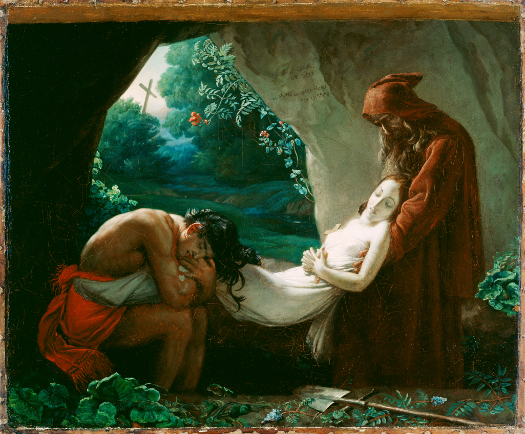
After Anne-Louis Girodet de Roucy-Trioson (French, 1767 – 1824)
Burial of Atala, after 1808, Oil on canvas
Unframed: 50.5 x 61.9 cm (19 7/8 x 24 3/8 in.)
Framed: 75.6 x 87.6 x 10.2 cm (29 3/4 x 34 1/2 x 4 in.)
The J. Paul Getty Museum, Los Angeles

Gerrit van Honthorst (Dutch, 1590 – 1656)
Christ Crowned with Thorns, about 1620, Oil on canvas
Unframed: 222.3 x 173.5 cm (87 1/2 x 68 5/16 in.)
Framed: 254.6 x 204.5 x 10.5 cm (100 1/4 x 80 1/2 x 4 1/8 in.)
The J. Paul Getty Museum, Los Angeles
Paris… in China

Do you like crazy architectural projects? Things like the World islands in Dubai? Or Habitat 67 in Montreal? Well, here’s another one for you. Tianducheng, China, was developed as ‘the Paris of the east’ in 2007, complete with its own copy of the Eiffel Tower. It was reported to be able to house 100,000 residents. There were also plans for a country club, a school, and a hospital.
Unfortunately, these big projects go wrong as often as they go right. Much like the World islands (look at it on Google Maps and marvel at the lack of actual development), Tianducheng never really took off. At last count, there were about 2000 people living there, making it something of a ghost town. Business Insider has a great slideshow of pictures showing the city.
Tianducheng from caspar stracke on Vimeo. |